
Track Tragedies
Outside the Lines (Sunday, 9 a.m. ET, ESPN)
https://www.youtube.com/watch?v=bx6-T_ha8B8
The Belmont Stakes could produce the first Triple Crown winner in 34 years. But the sport of horse racing has not had much to celebrate of late, particularly at a venerable New York race track just 10 miles from Belmont. This year, Aqueduct Racetrack wrapped up a deadly season that claimed the lives of more than 20 horses and prompted intense scrutiny of the dangers and the drugs involved in the sport of kings. Jeannine Edwards’ investigation includes interviews with Jim and Sue Hopper, owners of Sheeds Paisley, who died at Aqueduct in February.
Edwards visited with the Front & Center podcast (full interview available at iTunes.) Here are excerpts from the interview:
Jeannine on 23 equine deaths in 18 weeks at New York racetrack
Jeannine on telling a national story through the lens of Aqueduct
Jeannine on the emotional interview with the Hooper couple
“She was just lying there, and you could see immediately it was an injury that she would not be saved from. And, Jim (husband) was like, don’t go over there, it’s just too, too horrible. But, I had to be with her.” – Sue Hopper, owner of Sheeds Paisley, who died at Aqueduct in February
“Even though the regulations are in place, there’s not much enforcement and there’s not much surveillance of what’s going on.” — Dr. Kathryn Papp, private practice veterinarian at Pennsylvania and New Jersey tracks
“There is certainly pressure on the regulatory veterinarians to pass horses and not scratch horses. Trainers and the owners get upset. Their investment’s gone.” — Celeste Kunz, former chief regulatory veterinarian for New York State
The Dream Team
SportsCenter (Sunday, 10 a.m. ET)
https://www.youtube.com/watch?v=2_JF6SoBe2M
Twenty years ago, the USA men’s basketball team — “The Dream Team” — began its quest for the gold medal at the 1992 Summer Olympics in Barcelona. During their dominant march to the championship, they also restored America’s reputation as the world’s best in basketball, which was tarnished after losing to the Soviet Union and settling for bronze at the 1988 Summer Games in Seoul. Jeremy Schaap looks back on the Dream Team’s creation, its most-memorable moments and enduring legacy.
“We all cringed because we didn’t need to do that. We didn’t have to do that, because we were already better than everybody else.” — Magic Johnson,on his reaction to Charles Barkley elbowing an Angolan player during the Dream Team’s first Olympic game
“I think people can say, ‘Dream Team II’ or whatever they want, but, there will never be a team like that one. Those are 11 Hall of Famers, and no team will ever be like that.” – Mike Krzyzewski, former Dream Team assistant coach
The Homestretch
SportsCenter (Friday, 11 p.m., ESPN)
ESPN Deportes SportsCenter (Friday, 10 p.m.)
https://www.youtube.com/watch?v=cYDVNo5eZpo
Mario Gutiérrez, the jockey for Triple Crown hopeful I’ll Have Another, started racing horses in his native Mexico, but after being recruited to ride at Hastings Racecourse outside Vancouver, his career took off. A week before his attempt at horse racing’s first Triple Crown since 1978, Gutierrez made a trip back to the Vancouver track that changed his career path, visiting with the people he considers his second family. Tom Rinaldi reports on the jockey’s amazing journey, and the men who took a chance on his talent.
“I have everything here. I have all my friends in Hastings, the people who knew me from when I was only Mario. They knew me when I didn’t have anything. I like to be with them because I’m not going to change.” — Mario Gutiérrez, jockey, I’ll Have Another
“He’s come from humble beginnings. This is a fairy tale story. You know, like he says, ‘If I’m dreaming, don’t wake me up, please.’” — Glen Todd, horse owner and close friend who recruited Gutierrez
Too High a Price to Play
espnW.com
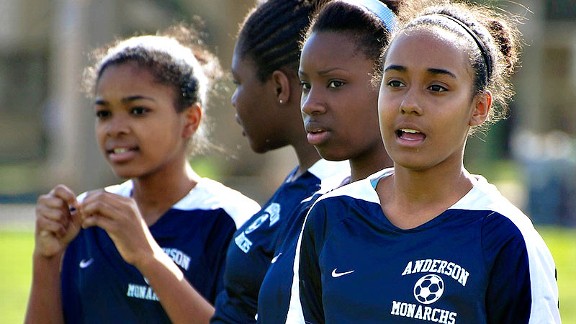
Tom Farrey writes: “Title IX has helped create thousands of girls’ sports teams in high schools and colleges since it was signed into law by President Richard Nixon on June 23, 1972. But some groups have benefited more than others. Among high school sophomores, white girls have a much higher participation rate (51 percent) than African-Americans (40 percent), Asian/Pacific Islanders (34 percent) and Hispanics (32 percent), according to a 2007 report by the U.S. Department of Education.”
“It’s difficult when you realize you’re one of a few.” — Shannon Boxx, one of two players of color on the USA’s 2011 Women’s World Cup team